
Ozmium
Litepaper
Ozmium's litepaper: the AiFi thesis, how the terminal and agent API work, what OZ does, the node and validator program, and where this is going.
Revision of September 6, 2026
Abstract
Ozmium is a non-custodial terminal for onchain finance on Base, and a per-call API that gives autonomous software the same capabilities. People trade, earn, borrow, and take leveraged positions through an interface that never holds their assets. AI agents do the same over HTTP, paying in USDC per request, with no account and no API key.
These are one system with two front doors. The hard problem in onchain finance is not broadcasting a transaction; it is being correct about the state of five protocols that do not agree with each other. Ozmium sells that correctness, to whoever is asking.
1. The Problem
A position spanning several protocols is, in practice, five applications with five mental models. Yield sits in one, borrowing in another, perpetuals in a third, spot in a fourth, liquidity in a fifth. Each scales parameters differently, encodes decimals differently, and means different things by the same word.
For a person that costs comprehension. Answering how much of this asset is actually free requires holding several screens in your head at once.
For an autonomous agent it costs far more. Before acting, it must find a price feed, find a second to check the first, learn each protocol's parameter scaling, get decimals right, encode an approval, encode the action, then discover which of those it got wrong by watching a transaction revert and paying for the privilege.
Same root cause. Same solution.
2. Architecture
Ozmium reads public onchain state, reconciles it, and constructs transactions. It operates no
contract that holds user funds, never signs, and never takes custody. Every write resolves to a
standard Base transaction of the form { to, data, value }, which the user's own wallet displays and
approves.
| Layer | Function |
|---|---|
| Read | Base state over JSON-RPC, cross-checked against independent market data |
| Reconcile | One ledger, with positions nested under the asset that funds them |
| Construct | Calldata encoded against exact mainnet addresses, scales and decimals already correct |
| Sign | The user's wallet, on both the human and the agent path |
Counterparties
Ozmium routes to protocols that remain directly usable without it, permanently and for free.
| Protocol | Role |
|---|---|
| Morpho | ERC-4626 vaults, Blue variable-rate markets, Midnight fixed-rate books |
| Aave v3 | Supply markets and collateralized borrowing |
| Gains Network | gTrade perpetuals on USDC collateral, up to 200x, across six asset classes |
| Aerodrome | The OZ/USDC vAMM pool |
| Uniswap v3 | The OZ/WETH one percent full-range pool |
| Coinbase Developer Platform | Swap routing, the hosted on-ramp, Base Account |
If Ozmium disappeared tomorrow, every position remains yours and remains manageable at the protocol that holds it. That is the test worth applying to any interface, this one included.
The Governing Rule
Never fabricate. A failed price read holds its last known-good value and marks it stale instead of printing a confident zero. An agent's factual claim is blocked unless a tool call backs it. A market order the venue never filled is surfaced and recoverable, not silently absorbed. Each is a decision made after watching the alternative cost somebody money.
3. How It Is Priced
People pay nothing. No subscription, no account, no cut of swaps. Reading requires no wallet at all: vault lists with live APY, loan markets, and the full tradeable pair universe render before anything is connected.
Machines pay per call over the x402 protocol, settled in USDC on Base. Payment is the credential and the paying wallet is the identity, so there is no signup, no key, and no key rotation.
| Tier | Price per Call |
|---|---|
| Data Reads | $0.001 |
| Focused Analysis | $0.005 |
| Strict Ideas | $0.008 |
| Ranked Alpha | $0.01 |
| Transaction Builders | $0.01 |
Congestion surge is capped at 2x. Prepaid OZ credit pays half of every price and is exempt from surge entirely. The authoritative price for any endpoint is the one in its own 402 challenge.
The asymmetry is deliberate. A person browsing costs almost nothing to serve; sustained automated call volume does not. Charging where the cost actually falls is what lets the human side stay free permanently rather than provisionally.
4. AiFi, Defined
AiFi is financial infrastructure whose primary consumer is software rather than a person. Not a chatbot bolted to a trading app, and not an API added to a product built for humans. It is the recognition that an autonomous agent is a different kind of customer, and that serving it properly changes what you build.
The distinction is concrete. A human customer supplies judgment the software does not have: they notice a number looks wrong, infer staleness from a greyed-out panel, and hesitate when two figures disagree. Every interface built for people quietly depends on that judgment. An agent supplies none of it. It will act on a stale price with the same confidence as a fresh one unless the system itself carries the uncertainty.
So AiFi has four requirements that ordinary DeFi does not:
| Requirement | Why It Is Not Optional |
|---|---|
| Priced per call | An agent cannot negotiate a plan or ask someone to provision a key |
| Discoverable without a human | Nobody is available to read documentation and sign up on its behalf |
| Self-describing | The contract has to be machine-readable, because there is no one to interpret it |
| Honest about uncertainty | Absent human judgment, staleness and disagreement must be stated in the data |
Why it matters. Agents that transact are arriving whether the infrastructure is ready or not, and the failure mode is not dramatic. It is quiet, expensive, and repeated: an agent that acts on a number no one told it was stale, or encodes a parameter at the wrong scale, or asserts something it never checked. At human speed those errors are caught. At machine speed and volume they compound.
Why Ozmium is a working example, not a claim. Every property above is already load-bearing here:
- Payment is authentication. A valid x402 payment is the credential, the paying wallet is the identity, and there is no signup, no API key, and no key to rotate.
- Discovery is published, not requested: OpenAPI 3.1, an MCP tool manifest, x402 discovery, an ACP descriptor, an agent-skills index, and a plain-text corpus for language models.
- Prices are read from a live 402 challenge, not hardcoded, so a price change cannot silently break a client.
- Uncertainty is in the payload. A failed read returns last-known-good marked stale, never a confident zero, and the marker feeds are labeled unproven in the response itself.
- The same endpoints serve the same capabilities to the app a person uses, so the agent path is not a degraded subset maintained separately.
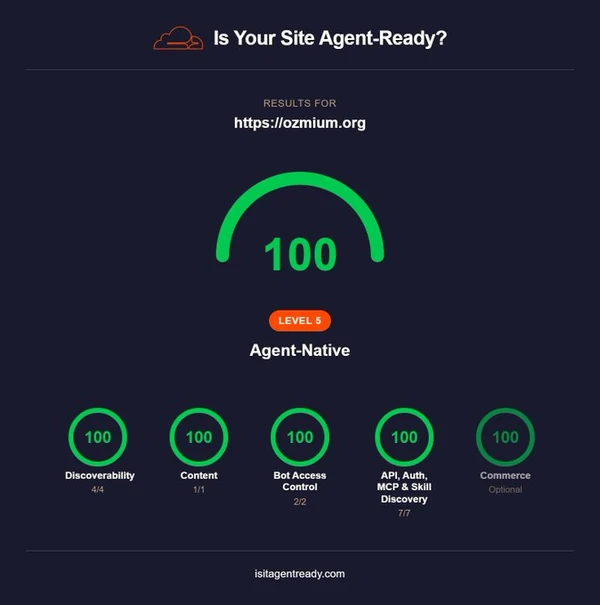
None of that is self-assessed. Cloudflare's isitagentready.com grades sites on exactly these properties, and Ozmium scores 100 out of 100 at Level 5, Agent-Native, including a full score in the optional commerce category, which requires the site to actually accept a machine payment, not just describe one.
The last point is the one that makes the rest credible. An agent API built beside a human product tends to rot, because nothing forces it to stay current. When it is the product, correctness stops being a maintenance burden and becomes the only mode the system has.
5. Why Agents Need Different Infrastructure
That agents will trade is not the interesting part. The infrastructure they need differs in kind from what people need, and almost nobody is building it.
An agent cannot read a chart. It cannot infer staleness from how a page looks. It has no way to notice two feeds disagree unless something tells it. What it needs is a machine contract: priced, discoverable, self-describing, and honest about its own uncertainty.
Ozmium publishes that contract in the open, through an OpenAPI 3.1 document, an MCP tool manifest, x402 discovery, an ACP descriptor, and a plain-text index for language models. An agent finds the service, reads prices from a 402 challenge, pays, and acts, with no human provisioning anything.
That is what AiFi means here, and it is meant literally: identical capability, priced for whoever is asking, regardless of whether they are a person.
6. What the OZ Token Does
OZ is a Base ERC-20 and a consumable. Its functions are mechanical.
| Function | Effect |
|---|---|
| Prepaid Credit | Halves every agent API price, exempt from surge |
| Desk Access | An onchain transfer authorizes each prop desk action |
| Liquidity | Seats the OZ pools on Aerodrome and Uniswap |
| Burn | A public, permanent ladder derived from chain state |
There was no developer allocation and no dev buy at launch. Early buyers and snipers took the exit liquidity, which was permitted rather than defended against, because a token whose point is utility does not need its price protected on day one.
OZ is not offered as an investment. Holding it entitles you to nothing: no dividend, no revenue share, no claim on any asset, no governance right, and no undertaking by anyone to affect its price. Its value is whatever the services it buys are worth to the buyer, which is why every one of those services is priced in public and callable without holding any OZ at all.
7. Ozwald, the Local-Inference Agent
Ozwald is the Ozmium agent. It runs on hardware Ozmium owns rather than metered inference, holds threads where several people and several AI participants work in the same room, and refuses to assert an external fact it has not checked with a tool call.
| Measure | Observed |
|---|---|
| Model | GPT OSS 120B, MXFP4 |
| Context Window | 98,304 tokens |
| Draw Under Load | 57 W to 85 W |
| Idle Average | ~30 W |
| Energy Cost | Roughly $1.50 per full working day |
The power figures are ranges because they are measured continuously rather than quoted from a datasheet, and the panel reports them live. A 120-billion-parameter model answering between 57 and 85 watts occupies the range a bright incandescent bulb used to.
The Cost Argument
The reason this matters commercially is that the marginal cost of a conversation is electricity. Once the hardware is bought, an additional query costs a fraction of a cent in power rather than a metered token charge, and the bill does not scale with usage.
Compare that against what a small business is currently offered when it wants an assistant that knows its own data:
| Approach | Typical Shape | Cost Behavior |
|---|---|---|
| Per-seat SaaS assistant | Monthly fee per employee | Scales linearly with headcount, forever |
| Hosted API with retrieval | Metered per token, plus vector storage | Scales with usage, unpredictable month to month |
| Custom build on a hosted model | Agency or contractor build, then ongoing inference | Large one-time cost, then a permanent metered bill |
| Ozwald, local inference | Hardware once, electricity thereafter | Effectively flat, and falls per query as usage rises |
The third row is the one worth dwelling on, because it is what most small operators are actually quoted. A tailored assistant built by an agency arrives as a project cost plus a metered dependency that never ends, and the metered part is what makes the economics fail at small scale: the businesses least able to absorb an unpredictable monthly bill are exactly the ones being sold one.
Local inference inverts that. The expense is capital rather than operating, the data never leaves the building, there is no rate limit, no per-token accounting, and no vendor able to change the price of work already deployed. For a rural clinic, a farm operation, a co-op, or a municipal office, those properties matter more than a few points of benchmark performance.
This is not a claim that local inference beats frontier models at everything. It does not. The claim is narrower and more defensible: for a large class of practical business tasks, a capable model running on owned hardware at 57 to 85 watts is sufficient, and its cost structure is the one that actually fits the customer.
That is the same argument as the infrastructure program below, measured on a smaller machine.
8. Infrastructure
Most Ethereum infrastructure sits in a handful of cloud regions. That is a stated concern of the organizations who fund this ecosystem, and it is a problem geography solves rather than software.
Project Oz is Ozmium's node and validator program: Ethereum and Base infrastructure operated on carrier-grade regional backhaul, on owner-controlled rural land, outside the cloud regions where most of the network already sits.
The case rests on three things that are difficult to assemble anywhere else.
Backhaul that cannot be manufactured. A long-haul fiber trunk runs under the land, with commercial ISPs already riding that route. Generators, cooling, and racks can be bought anywhere. A trunk line that is not there cannot be bought at any price, which is what makes the site, not the building, the asset. Land control, not a lease. The landowner is a project partner and not a lessor, and their existing industrial blueprints already carry engineered datacenter plans. That removes the single largest source of schedule risk in a rural build, which is not construction but site control.
A funding stack that matches the asset. Ecosystem capital, the Base Ecosystem Fund, Coinbase Ventures, and the Ethereum Foundation's Ecosystem Support Program, overwhelmingly funds software and client work rather than concrete, and typically at five to six figures. Treating those programs as a building fund would be a category error. The structure is financed against infrastructure and energy capital, USDA Rural Development programs, state-level datacenter equipment incentives, and debt against land the partner already owns, with ecosystem grants sought as a credibility signal on the validator work rather than as the foundation.
What would genuinely interest Base or the Ethereum Foundation is the same property that makes the site defensible: client diversity and geographic decentralization. Most Ethereum infrastructure runs in a handful of cloud regions, which those organizations name publicly as a risk. A validator on independent rural backhaul, on owner-controlled land, with its own power story, is a direct answer. The building is how that gets delivered, not the ask itself. A separate public-facing interpretive facility, sited downtown instead of at the datacenter, makes the work legible: tours, an exhibit explaining what regional infrastructure does, events, and retail. The two are funded through entirely different channels on purpose. Municipal downtown revitalization money is well suited to the storefront and jurisdictionally incapable of touching the validator site, and applications that conflate them are rejected on jurisdiction before anyone reads the merits.
Site, landowner, route, mineral position, and cost are not published here. Those are disclosures belonging to the parties who own them, and a public number becomes the number every counterparty negotiates against.
9. Where Digital Meets Physical
A terminal and an API are digital products with a global market, and Ozmium sells to that market on its own terms. That does not conflict with what follows. It funds it.
The argument is that onchain infrastructure eventually has to touch something. Fee revenue, validator yield, and treasury are digital until they buy a building, seat a loan, or fund a prototype, and at that point they become ordinary economic development with an unusually transparent balance sheet. Ozmium is built to make that turn deliberately rather than incidentally.
The path runs in one direction and closes:
| Stage | What It Produces |
|---|---|
| Software | Terminal and agent API revenue, priced per call, global market |
| Infrastructure | Validator and node operations on owned land and independent backhaul |
| Real Assets | Commercial property, held and managed rather than flipped |
| Incubation | Capital and operating support for early ventures in the same region |
Base, Ethereum, and Circle's USDC make the first stage viable at a scale that matters here, because they are the first combination cheap enough and stable enough for someone moving a hundred dollars rather than a fund moving a million. That constraint shapes the product: tools priced for that person, and sometimes priced at nothing.
The later stages are what the first is for. A validator site is a physical asset with a power contract and a tax position. A commercial property is a rent roll. A revolving loan fund is capital that returns and lends again. None of that is speculative in the crypto sense, and all of it is more legible to a lender or a development authority than a token ever will be.
Bringing blockchain to a community physically rather than only onchain is the same commitment stated in concrete: infrastructure sited where people actually live, and a building anyone can walk into and be shown what it does.
10. The Wider Portfolio
One research investment, several delivery surfaces. These share a stack, an operator, and a discipline rather than a market.
Shipped and Building
| Product | Status |
|---|---|
| Bard: The Theremini App | Live. A browser-native air-theremin and Base mini-app, Base Builder Quest 7 finalist, awarded 0.5 ETH |
| Andhakara | Live. An onchain collectible card collection on Base with published pack odds and contract-readable economics |
| Engine | Research. Autonomous NPCs whose decisions run outside the renderer on local models |
| Amusement | Research. Locomotion controllers for a 14-joint bipedal robot, holding the sprint record and top overall standing on a public ladder as of September 2026. Simulation only |
How These Actually Connect
They look unrelated. They are not, and the connection is technical rather than thematic.
A game economy and a financial market are the same modeling problem. Balancing a virtual economy across a long horizon, whether sinks absorb faucets, whether a currency inflates, whether a market reaches equilibrium or spirals, has traditionally meant dense database instrumentation, bespoke telemetry, and a live population to learn from. Studios historically discover the answer by shipping and watching it break.
The primitives Ozmium already works against are the primitives that answer those questions directly. An automated market maker is a price-discovery mechanism. A lending curve is a supply-and-demand function with a solvency constraint. A liquidation threshold is a hard boundary condition. These are not analogies. They are the same mathematics, already implemented, already audited by their maintainers, and already observable in production.
Testnet and synthetic simulation make that nearly free. Deploy the mechanic on a testnet, or model it synthetically against the same contract logic, and long-horizon balancing becomes an experiment rather than a build. No production database to instrument. No storage cost that scales with player count. No live population to risk. And because nothing of value is at stake in a synthetic or test environment, the regulatory surface is minimized to the greatest extent the question allows, which is precisely the freedom you need to iterate on an economy fast.
The agents are the same agents. The Engine's characters make decisions outside the renderer as independent processes. Ozmium's API already treats autonomous software as a first-class customer that pays, reads state, and acts. A non-player character reasoning about scarcity and a trading agent reasoning about a position are running the same loop against the same kind of interface. Work on either improves both.
The body is the last surface. A locomotion controller is a policy that reads an observation vector at 50 Hz and writes joint targets, trained in a simulator and measured on a fleet nobody owns. The decision layer above it is the same process that runs an Engine character and the same one that runs the desk. Amusement is where those meet, and what a character has to prove before it works a room with people in it is written down there in advance.
And the surfaces feed each other. Bard proved the mini-app path, wallet handoff, and install flow that Ozmium now uses. Andhakara is a live economy with published odds and contract-readable pricing, which is a real dataset about how people behave toward randomized value. Ozwald is the agent substrate. The Engine is where mechanics get tested before anything is at stake.
One research investment, several delivery surfaces, and each surface is a test rig for the others.
Ventures and Property
Two arms operate off the balance sheet rather than the product surface, and both predate any of this being described as a crypto company.
Startup consulting and partnership. Ozmium takes early positions in regional ventures, typically at the prototype and first-grant stage, contributing the parts a technical founder in a rural county usually cannot buy: funding strategy, application drafting, technical architecture, and operating support. Current work concentrates in agricultural technology, where the domain expertise is local and the capital access is not. Positions are taken as partnership rather than as fee-only consulting, so the incentive matches the outcome.
Commercial property and strategic management. A separate consultancy handles property selection, funding-program strategy, and asset management for commercial real estate, alongside a portfolio arm that holds and operates buildings directly. The credential behind it is real rather than adjacent: certified administration of state community-development block grant programs, and end-to-end operation of a revolving loan fund.
That arm is why the infrastructure program above is credible. Assembling a site, a funding stack, and a jurisdictional strategy is the work that arm already does, applied to a datacenter instead of a storefront.
11. Capital and Hiring
Ozmium is actively seeking funding, with several grant, lending, and equity programs pending and others being pursued. The stack is deliberately mixed rather than dependent on any single source: competitive grant programs, subsidized and conventional lending, ecosystem funds, and equity where the terms fit the asset being financed.
Capital is sought against specific outcomes rather than as a general raise. An independent security audit of the interface is the first line item. Infrastructure capital is scoped separately from software, because they are different assets with different lenders.
Hiring is a funded outcome, not an assumption. Three roles are planned as capital allows, and each is being pursued through workforce and job-creation programs that subsidize or underwrite the position rather than through burn alone.
| Role | Scope |
|---|---|
| Solidity Engineer | Contract work, audit remediation, and onchain systems for the desk and token rails |
| Community Lead | Discord, support, documentation feedback, and the loop between users and roadmap |
| Marketing | Positioning, partner and ecosystem relationships, and the agent-discovery surface |
Roles are expected to be hybrid, which is a deliberate choice rather than a concession. The infrastructure argument in this document is that serious work does not have to happen in a coastal metro, and hiring is where that argument is either honored or quietly abandoned.
12. Candid Assessment
A litepaper that only argues its own case is marketing. This section is the version an investor or a lender would construct anyway, written first.
| Internal | External | |
|---|---|---|
| Favorable | Strengths. Non-custodial by construction, so user funds cannot be lost through operator failure. One codebase serves both the human and agent markets, so correctness work counts twice. Inference runs on owned hardware at a measured 57 to 85 watts, which removes the marginal cost that caps most AI products. Certified administration of state block-grant programs and end-to-end operation of a revolving loan fund, which is an unusual credential in this sector. Products already shipped and independently recognized. | Opportunities. Agents that transact are arriving and the infrastructure they need is largely unbuilt. x402 is early enough that being present matters. Geographic decentralization of validators is a publicly stated concern of the organizations funding this ecosystem. Rural infrastructure and energy capital is accessible in ways venture capital is not. Regulatory clarity for self-custodial software would remove the largest structural overhang. |
| Unfavorable | Weaknesses. Pre-revenue, with the only income to date being onchain token fees. Concentration risk in a small team is real and is not solved by asserting otherwise, and the hiring in section 11 is contingent on capital arriving. No formal third-party security audit of the interface. Marker feeds are explicitly unproven with no established out-of-sample edge. Token liquidity is thin. The physical program is capital-intensive and long-dated relative to the software. | Threats. A larger platform can build a comparable agent API, and would do it with more capital. Every routed protocol is a dependency whose failure becomes a user's loss. Regulatory treatment of onchain finance can change faster than a small operator can adapt. Adoption of agentic finance may arrive slower than the thesis assumes. Competing layer-2 networks could fragment the liquidity Base currently concentrates. |
Four of those deserve to be stated plainly rather than buried in a grid.
The audit gap is the most material near-term risk. The routed protocols publish their own audits; this interface has not been audited. That is disclosed on every relevant page rather than omitted, and it is the first thing meaningful capital should be spent on.
Concentration risk is genuine. A small team moves quickly and carries correspondingly little redundancy. The mitigation that actually holds is architectural rather than organizational: because nothing is custodial, the failure of the operator does not become the failure of user funds. Every position remains manageable at the protocol that holds it.
The physical program is not funded. Section 8 describes a structure and a strategy, not a financed project. It is presented as intent with a defensible funding stack, and should be read that way.
The agent thesis is a bet. If autonomous transaction volume arrives more slowly than expected, the human product still stands on its own, but the pricing model that makes the human side free depends on machine volume eventually materializing.
13. Status
Ozmium is in public beta. The interface is under active development, may change, and may be unavailable at any time. It has not undergone a formal third-party security audit, which is stated here rather than omitted. The underlying protocols publish their own audits; those are claims about them, not about this interface.
Important Disclaimers
No offer or solicitation. This document is provided for general informational purposes only. It is not an offer to sell, a solicitation of an offer to buy, or a recommendation regarding any token, security, financial instrument, or service, and it is not a prospectus or offering document of any kind. No part of it forms the basis of, or may be relied upon in connection with, any contract or investment decision.
Not advice. Nothing here constitutes financial, investment, legal, tax, accounting, or other professional advice. Ozmium is not a bank, broker, dealer, exchange, custodian, investment adviser, commodity trading adviser, money transmitter, or your counterparty, and does not solicit or recommend any transaction. Consult qualified professionals in your own jurisdiction before acting.
No warranty. The interface, the API, and this document are provided "as is" and "as available", without warranties or conditions of any kind, whether express, implied, or statutory, including without limitation any implied warranties of merchantability, fitness for a particular purpose, title, non-infringement, accuracy, or uninterrupted or error-free operation.
Limitation of liability. To the maximum extent permitted by applicable law, Ozmium, its operator, and its contributors shall not be liable for any direct, indirect, incidental, special, consequential, exemplary, or punitive damages, nor for any loss of profits, revenue, data, goodwill, or digital assets, arising out of or relating to your use of or inability to use the interface, the API, this document, or any third-party protocol reached through them, whether based in contract, tort, negligence, strict liability, or otherwise, and whether or not the possibility of such damages was advised.
Risk of loss. DeFi carries risk of total loss, including through smart-contract failure, oracle error, curator or market misconfiguration, illiquidity, bad debt, and liquidation. Leverage is high-risk: adverse price moves, funding, and borrowing costs can liquidate a position rapidly and without notice. This is not a bank deposit and is not insured by the FDIC, SIPC, or any government program.
Forward-looking statements. Statements about intentions, plans, roadmaps, or future capability are forward-looking and inherently uncertain. They reflect present intent only, are not commitments, and may change or be abandoned without notice. Nothing described as planned should be treated as existing.
Third-party protocols and marks. Protocols and services identified here are independent, are not operated by or affiliated with Ozmium, and are used at your own risk under their own terms. Product and company names are marks of their respective owners, used solely to identify those services; such use implies no affiliation, partnership, or endorsement.
Eligibility. You are solely responsible for complying with the laws of your jurisdiction, including any restricting leveraged or derivative products. Access is not offered where prohibited.
Governing document. Where this document and the Terms and Risk sheet differ, the Terms and Risk sheet governs, and where that sheet and the version displayed in the app differ, the app governs.
Read Further
| Subject | Page |
|---|---|
| What the App Does | About Ozmium |
| First Transaction | Quickstart |
| The Agent API | Agent API Overview |
| Token Mechanics | OZ Token |
| Custody and Contracts | Security and Trust |
| Risk in Full | Terms and Risk |